2 stages · 54 km

Gradients and elevation

Ascents: 57m
Descents: 52m
Lowest point: 0m
Highest point: 52m

Road types

38km (69%) By road
17km (87%) Cycle path
14km (25%) Provisional itinerary

Surface

39km (200%) Smooth

2 stages used

Rouen / La Bouille

9 Rouen / La Bouille

20 km
1 h 18 min
I begin / Family
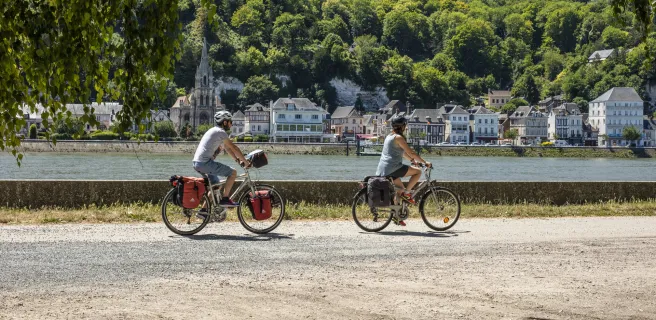
Leaving the bell towers of Normandy’s capital behind, cranes take over the skyline, signalling Europe’s largest port for the exporting of cereals. Enormous cargo vessels, some almost 300m in length, load up here. Gradually, heading west, the atmosphere changes, as typical Norman villages with old sandstone and timber-frame houses follow. You arrive in the heart of the Parc Naturel Régional des Boucles de la Seine Normande, where the relaxing feel is added to by the slow coming and going of vessels. Before boarding the ferry across the Seine to reach La Bouille, stop to see the gardens at the Château de Soquence, with a beautiful viewpoint over the river. On the other bank, you can spot the Château de Robert le Diable, historic guardian of this Seine meander. La Bouille, birthplace of 19th-century writer Hector Malot, proved a source of inspiration for Impressionist painters and makes a lovely place to stop.
La Bouille / Jumièges

10 La Bouille / Jumièges

35 km
2 h 19 min
I cycle often
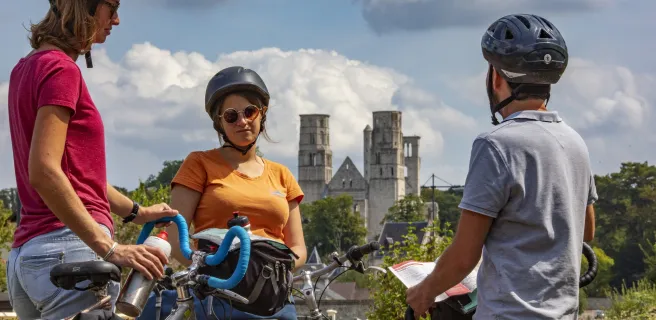
The Seine à Vélo cycle route leaves a spot so special to the Impressionists to follow the Route des Fruits, or Fruit Route. As well as admiring apple, pear, plum and cherry orchards, bearing fruit in different months, make the most of a trip into the heart of the Parc Naturel Régional des Boucles de la Seine Normande to visit local producers. Foodies might plan a special stop in the riverside town of Duclair, to taste its traditional speciality, pressed duck. If keen on history, visit the Château du Taillis, its museum dedicated to the war in Normandy in August 1944. End this stage in style, taking your bike on the ferry over to Yville-sur-Seine to reach the village of Jumièges, dominated by one of Normandy’s most remarkable medieval Benedictine abbeys. Victor Hugo described it as ‘France’s most beautiful ruin’. In this contemplative spot, enjoy a reflective pause before embarking on the last stages of the route, either heading to Le Havre along the north bank of the Seine Estuary, or to Honfleur and Deauville along the south bank.
Show stages